Showing posts with label Chickens. Show all posts

Thursday, June 10, 2010

Chicken Dreaming


I dreamed about the chickens last night. In the fragment I remembered as I awoke, I was holding them in my arms, feeling their soft silky feathers against my skin – just briefly. Then they fluttered away and through a pop door that led somewhere I couldn’t see. (It wasn’t the pop door to their coop.) And they were gone.

I sold the remaining two chickens shortly after Batgirl died. We got an offer on our house from the very first guy who toured it at our very first (and only) open house. So I knew I had to find new homes for the chickens. (We’ll be staying at an apartment while we plan and build our next home.) For some reason, it seemed easier to do after Batgirl died. Kind of like ripping the rest of the band-aid off quickly.

Their departure has left a hole in my life. I had them for just a year plus a few weeks, but they managed to thoroughly integrate themselves into my daily routine. First thing in the morning, I’d look out my bedroom window while I was pulling on my jeans to see what they were up to. Then I’d bring them their morning greens and fresh water.

Now there are no little chickens to greet me enthusiastically in the morning. Nothing to see when I look out the window, except a big wound in the garden where their coop (now sold) once stood. No real motivation for digging the big dandelions that emerged after all the rain last week out of the lawn – because there is nobody to get excited about them and gobble them down voraciously. When I step out the back door to snip a few herbs for cooking, no little birdies start squawking and banging their beaks on the wire of their cage, hoping to be let out. No eggs to collect and marvel over. “How many today?” we’d ask each other. We had five dozen in the fridge when they went away.

I miss them, but I hope they’re enjoying a better life – meaning more space – in their new home. At least that’s what the guy who bought them promised.

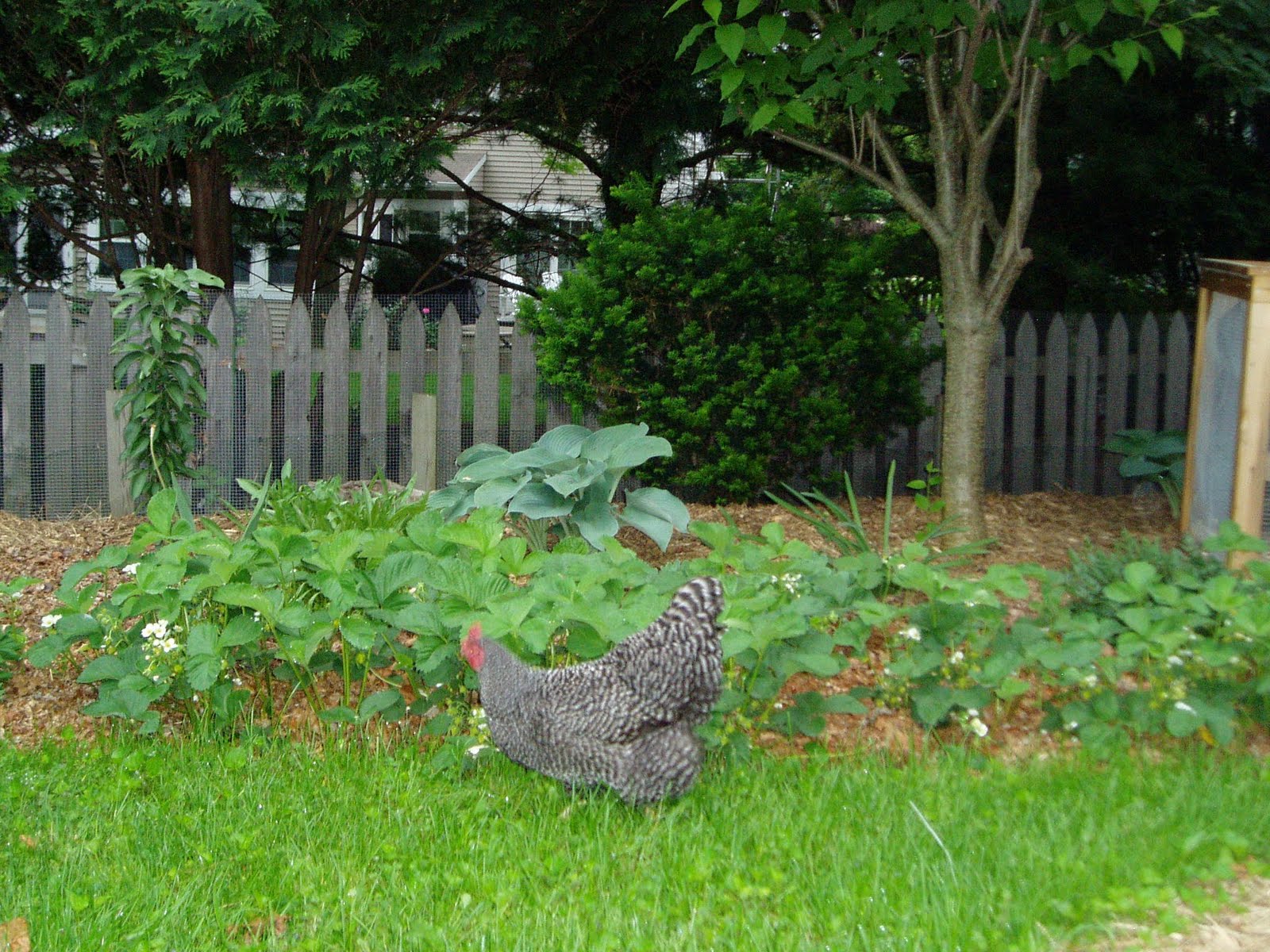
The photo above is a good representation of what I imagined having chickens would be like. They’d be an attractive garden feature, wandering through the yard, their gorgeous feathers contrasting beautifully with the foliage and flowers of the garden. They’d not only produce eggs for us to eat and manure for the garden, they’d be living “lawn ornaments”.

Of course, the reality is that they would tear up the garden in a heartbeat if I let them run free. They’d eat what I didn’t want them to eat, dig huge holes all over the place, and drop their uncomposted manure everywhere.

I took that photo of Amelia a few days after Batgirl died. I was tending the remaining chickens, but distracted by thoughts of Batgirl. In my absentmindedness, I failed to close the door to the pen all the way when I came in, and Amelia quickly ran out. It took me more than an hour to catch her, but truthfully, I wasn’t trying very hard that whole time. I was observing her and snapping a few photos. My fantasy had been that, shortly before we moved out of this house, I would fling open the door to their pen and let them all run free in the garden for a day.

Long-time readers of this blog will recall that
I have struggled with the problem of having to keep the chickens penned and wanting to give them the space and freedom all living creatures seek. Our goal at our new place is to have enough land to give them just that; to allocate a large area for them to run outside, chase bugs, dig worms, eat what foliage they desire, and generally live the good chicken life.

So while I miss my chickens, I try to imagine them enjoying a life in the country, and look forward to giving our next chickens the same benefits after we move. It’s hard, however, not just to give up the chickens, but to leave the garden. I thought it would take much longer to sell the house, that I’d have one last summer to enjoy what’s shaping up to be our best garden yet.


Already we have harvested pounds and pounds of strawberries. They’re larger than the ones I grew a couple of years ago in the planter boxes and much juicier and more flavorful than the ones you buy in the grocery store. So far, I have canned seven jars of jam, 4 jars of strawberry syrup, and Rick has frozen two quarts of whole berries. Plus we have eaten many and given some away. Last evening he came in with that half peck box overflowing with yet more strawberries – and they’re still coming! All from an $8 package of strawberry roots I bought last spring.

The sweet potatoes I over-wintered survived and transplanted well, the potatoes are going gang-busters, and the tomatoes I started from seed in the house are my biggest and strongest seedlings yet. But I have to look to the future – to having more space for both chickens and garden, as well as a more energy-efficient home.

My last post for this blog will be up early next week. In it, I’ll detail the reasons why I feel it so important for all of us to get going on growing more of our own food. I’m taking my time with it because I want to provide plenty of links to other articles. I’ve been steeped in this stuff for six years, but some of the issues may be new to some people. So I want them to be able to read more about it if they’re interested. Look for the post on Monday or Tuesday.

Monday, May 24, 2010

Farewell, Batgirl!

Batgirl - around 3 weeks old

Batgirl (Barred Rock in background) last summer


My very favorite chicken died yesterday. I was stunned; am still stunned. She showed no signs of ill health and was frisky that morning. When I went out to give them their morning greens and fresh water, she pecked at my jeans like she often does so I would pick her up. She only tolerates a few seconds of petting; then she wants to be free. But she seems to want just that little bit of attention.

When I went out in the afternoon, she was lying on her side in the pen, beak tucked into her breast. The other two were hanging out in the side pen, as far away from the corpse as they could get. I couldn’t even go into the pen. I ran back to the house calling for Rick. He checked her and confirmed what I knew; she was definitely dead; stiff as a board. My neighbor who grew up on a farm suggested it was the sudden heat that did her in. After a spell of cooler-than-usual spring weather, it suddenly got hot, with a high of 88 frickin’ degrees yesterday.

I guess I didn’t think carefully enough about how to protect them in these conditions. There are trees on either side of their pen, so they get lots of shade and had plenty of water. But apparently that wasn’t enough. Today I’ve been supplying the remaining two with ice-filled plastic containers they can cool off next to, ice in their waterer, and tomatoes and cucumber. Hopefully, all of that will keep them reasonably cool and hydrated.

Batgirl was the first chicken to ever touch my heart; heck, the first animal to do so. At 52 years old, I never had any pet or livestock before these chickens. How do they cluck their way into your heart? I don’t know; she just did.

Things I loved about Batgirl (in no particular order):

• I loved how she always tried to escape and be free. She’s a major reason I want to move somewhere with more land. I want to give my chickens lots more space to roam and play. Batgirl was our best escape artist – sneaking under netting, flying over it, nimbly flitting past me when I opened the door to their tractor or pen. I silently cheered her every time she made it through.

• I loved how when she escaped by flying over the temporary netting I’d put up in the yard, she’d come over to where I was working in the garden and stay next to me, scratching in the soil alongside me.

• I loved how she was always the bravest and first to try anything new. Like when she was just a couple weeks old and we put a low roost in the brooder. She investigated the new item immediately, hopped up on it, and tried to walk along it like a balance beam. She looked like a little toddler, unsteady on her feet and was adorable when she fell off.

Or when we started taking the 5 week old chicks outside. We’d put a smaller box with chicken wire over the top and a drop down door cut into it inside their brooder and try to get them to walk in. Then we’d close the door and carry them outside in the box. While the others resisted walking into that box, she’d brazenly march right in. Of course, she crapped immediately and panicked when we shut the door, but once we got her outside, she had a great time.

• I loved her independence. Although she didn’t stray too far from the group, she liked to keep a little distance between herself and the other hens. She was happy off doing something else by herself.

• I loved how she would pout when something didn’t go her way. She’d turn her back on you and take a few hops in the opposite direction. Sometimes she’d even turn back, look at you again, and take a couple more hops. Just to make sure you got the message. She stayed mad at Rick for about a week in winter when, against her will, he put bag balm on her comb to prevent frostbite. She really hated that indignity.

• Her latest funny thing: whenever I’d transfer them from pen to tractor, she wouldn’t go. The other two would run obediently from one place to the next, but she’d just stand there, looking at me and making some kind of mewling sound. It’s hard to describe – it wasn’t the clucking sound they make when they’re contentedly digging. But there she’d wait, at the door of the pen, for me to pick her up, pet her once or twice, which was all she could take, and then put her in the tractor. Why she had to have me physically move her, I do not know. I guess she just wanted a little attention.

Unlike the other hens, she really seemed like she wanted to interact somehow, if just for a few moments. The first time she pecked at my clothes, I freaked out for a second. Then I realized she wasn’t being aggressive, and maybe just wanted attention. In winter, when I’d give them their greens in the morning, she’d peck at my coat pocket, wanting me to bring out the little bag of cracked corn she knew I’d have. Unlike the others, she loved that corn more than greens (and they all love their greens). Other times, she’d just peck at my jeans a couple of times. When I’d turn to her, she seemed to look right at me, like she wanted to communicate.

Probably I’m imagining it, or reading too much into her little chicken behaviors. But I feel that somewhere in there a little spark connected her little chicken soul to mine. Farewell, little Batgirl. I miss you so much.

Friday, May 21, 2010

Catching Up


We’ve been so busy preparing the house to go on the market that I’ve neglected this blog. I really miss it, too. I enjoy writing it, but also think I need it for my mental health! I even sleep better when I’m writing regularly. But we’re done with the hard labor, having our first open house on Sunday, and I’ve got a backlog of ideas for posts. The first is a quick “catching up” entry.

Happy Hatch Day!
I meant to do a special post for the chickens’ first hatch day, and somehow let it slip by! I got them as day-old chicks on May 12th last year, so as far as I can tell, they were hatched on May 11th. What an interesting year it’s been. I’ve gone from being someone who never had or wanted any pet or livestock, who was a bigger “chicken” even than the chickens, easily spooked by their sudden movements and fearful of picking them up, to someone entirely comfortable handling them and fairly knowledgeable about their care.

I planned to experiment with putting up videos using one of them as baby chicks and one I just took the other day. However, I can’t find the baby chicks video. Now that I think about it, I’m pretty sure I deleted it one day out of embarrassment. I was talking away to the little chicks on it. Now I’ve really gone over to the other side and don’t care what people think about me talking to the chickens.

So here is a still photo of the baby chicks, followed by a video taken a few days ago of the girls all grown up. (The photo was taken when we still had the ten chicks. When they were two weeks old, I gave six away because we’re only allowed to have four in the city.)


[Okay, I've tried loading this video for two hours and it never finished. I'll try making the file smaller and attempt another upload later.]

Current state of the Garden


Look at these cherries – aren’t they gorgeous!!! I’m lucky they’re still so beautifully healthy. According to the books, I should have sprayed by now. But my preferred fruit tree pest control product, Surround (kaolin clay) isn’t locally available. I called everywhere I could think of and most didn’t even know what it is. One sales person, assuming I didn’t understand what I was asking for, patiently explained that they didn’t carry it because customers didn’t like the look of it! Isn’t that the American way – style over substance? It’s true that covering your lovely trees with a fine mist of white clay is less visually appealing than glossy green leaves, but hey, I’d rather do that than eat chemical pesticides.

The only way to get it is to order it online, and it’s clay – it’s heavy - the shipping costs almost as much as the product. The smallest quantity I could get was 25 pounds, which will last years and years with just a small number of trees. But I took a deep gulp and finally ordered some because before we move, I really, REALLY want to taste at least a few cherries off those trees we have worked so hard to nurture. We should probably go all out and have some champagne with those cherries – they’re going to be the most expensive ones we’ve ever eaten!

The strawberry plants are loaded with fruit, as are the blueberries, and the raspberries are covered with flower buds. Tonight I’m planting out my tomatoes, sweet potatoes, peppers, cilantro, parsley, basil, and eggplant. I’ll put up some photos afterwards.

The “It’s for Everyone” Argument and Social Control
The other night I was flipping channels before going to sleep and found the 1975 film One Flew Over the Cuckoo’s Nest playing on TCM. Of course, I had to stay up late and watch it all the way through. It’s an amazing film. On one level, it’s about institutional control over individuals and crushing the human spirit. Jack Nicholson’s character, Randle McMurphy, opts for a mental institution to get himself out of a hard labor prison sentence. But he finds himself in a new kind of prison.

Anyway, the incident relevant to this post occurs when rebel McMurphy politely asks during group therapy session whether the work schedule might be changed to allow the men to watch a World Series game. Nurse Ratched explains in her calm, controlled, and steely manner, that a lot of thought is put into the schedule, that changing it may be upsetting to some patients. The schedule, like the constant anesthetizing music, she says, is for all the men on the ward. But she offers a vote on the matter, confident that the men are too cowed by her to side with McMurphy.

The vote fails, but on a subsequent day, Cheswick, who voted with McMurphy, asks for another vote. Irritated, Ratched reminds Cheswick that they had a vote. Cheswick presses the issue, pointing out that there is another game on today. Ratched allows the vote; this time all the men vote with a jubilant McMurphy.

Ratched looks around the group at calmly before telling McMurphy, “I see only 9 votes. There are 18 men on this ward.” The other nine she refers to are too out of it to even participate in the group therapy sessions or understand that a vote is taking place. They orbit around the dayroom, lost in their own worlds. McMurphy later complains to the doctors that Nurse Ratched “likes a rigged game.”

I woke up the next morning thinking about how the argument that the schedule could not be changed because it was for everyone was like the argument that we can not have a community garden in the park because the park is for everyone. It’s an argument that seems, on the surface, like ethically based opposition to changes in the system. We are looking out for everyone. You are asking for changes that will only benefit you. Don’t you see how unreasonable and selfish that is? Democratic rituals and phrases are used to uphold the system and enforce control. You are the crazy one, if you don’t see and appreciate the fairness and rationality of the system. I’m still thinking through the full implications of the analogy.

Friday, April 30, 2010

Chicken Pickin's


Is there a way to minimize purchased inputs when it comes to your chickens? Obviously, a backyard is too small to grow grains for their feed. Eventually, I want to learn how to grind and mix my own feed. Many people recommend that. For now, however, I buy them a high quality organic layer feed.

Traditionally, people have supplemented their chickens’ diets with kitchen scraps and leftovers from human dinners, using the chickens, in the words of our extension agent, as “garbage disposals.” I haven’t done much of that, for several reasons. First, I doubt whether, left to their own devices, chickens would make a fire and cook up some grub. It seems to me that it is more natural for them to eat raw food.

Secondly, much of what humans (American humans, anyway) eat these days is not healthy for humans, let alone chickens. We try to eat healthfully most of the time, but we enjoy things like chocolate cake now and then (more often when I was younger and could more easily keep the weight off!) I wouldn’t dream of giving chickens chocolate cake. They’d have to fight me for it, like anyone else, and although at 4’9” tall I’m smaller than most grown people, I’m bigger than a chicken!

Seriously, the white flour and sugar are empty calories, let alone the hazards of the giving chocolate to animals. If you think I’m crazy to even mention chocolate, you should check out the Backyard Chickens message board sometime. I once saw a post asking whether it was okay to give chickens chocolate. Some of the moderators eventually put together a list of safe “chicken treats” in response to all the questions they were getting.

I’m not trying to put down posters on that site. Some terrific people post over there and I don’t know how I would have made it through my first year of chicken keeping without them. Everyone is extraordinarily helpful.


It is also the largest site devoted to backyard flocks that I know of, and so is a great place to get a sense of what’s going in with the trend. The problem I see is that many people want to treat chickens as pets rather than livestock. Even when you start out, as I did, with the intention of treating them as livestock, if you have just a small number of birds, you find yourself naming them and getting attached to them whether you want to or not.

One problem with treating them as pets is the desire to give them “treats.” People want to give their beloved pets foods they (the humans) enjoy. The result is a lot of fat family dogs and cats. Even foods like pasta, unless it is whole grain, can contribute to obesity (as with humans) because it is mostly empty carbohydrates. Our extension agent says many of the chickens kept in backyards are obese and that obesity causes many of the reproductive disorders you see in chickens, such as double-yolked eggs, internal laying, and prolapses.

What I’ve tried to do is observe my chickens and let them educate me about their diet. They have tiny brains, but they are programmed with specific information related to their survival as a species.

What I’ve learned from my chickens is this:

* They do not particularly care for cooked food, even on a cold winter morning. I’ve read and heard from many sources that cooked grains are good for warming up chickens in winter. Mine had no interest in the oatmeal I lovingly prepared for them. I offered it a couple of times, thinking maybe it was just unfamiliar to them. The only time they went for it was when I put diced apple in it. Then they just picked out the apple! I tried making a porridge of their layer mash and hot water, but they didn’t go for that, either.

Unlike many other chickens I’ve read about, mine do not care for pasta. I even offered them the good stuff, whole grain pasta. They nibbled a bit, turned up their beaks, and walked away. The only cooked food I ever got them to eat was popcorn. But they only like it occasionally.

* They are omnivores; consequently, they usually don’t want the same treats over and over. I knew, intellectually, that they are omnivores, but it didn’t really sink in until I tried giving them something they seemed to like more than once. They went crazy for popcorn the first time I gave it to them, so I made it again the next day. They just looked at me, as if to say, “Popcorn, AGAIN? With no movie? What else have you got?”

Similarly, when they were molting in winter, I read that you should give them a little extra protein. Some people give them dog or cat food, but I questioned the quality of that. Then I read about a woman who gave her chickens deer liver when they were molting. Since liver is a high quality protein, and I happened to some pastured turkey livers in the freezer, I offered them liver. They went crazy for it. The next day I brought out more, and they were, “meh.”

* The “never fail” treats they will always go for, no matter how many days in a row or times per day you offer them are greens, bugs, worms, and grubs. Big surprise, huh? These are the foods closest to what their ancestors, Asian jungle fowl, ate in the wild. The great thing is, you can give your chickens their favorite (and most healthful) treats and minimize purchased inputs at the same time! One of their favorite treats is dandelions, which are extraordinarily nutritious (for people and chickens!).

Whenever Batgirl, one of our Barred Rocks, gets away from me, she makes a bee line for the raspberry and strawberry patch. So now I give them leaves from raspberry shoots coming up where I don’t want them, as well as leaves from extra strawberry runners. I’ve also given them extra parsley from the herb bed, volunteer squash shoots coming up in the compost, pea vines after I harvest the peas, and carrot tops. They also love the leaves, flowers, and seeds of sunflowers – the only crop I plant specifically for them.

Last summer when I was moving their tractor to a new spot on the lawn, I happened to pass over an ant hill and they went crazy. So I just left the tractor there, and they had a blast cleaning out the ant hill. The next day I set them over another ant hill and fairly quickly had my yard cleaned of ants.

One of the hard realities I’ve learned about backyard chickens is that you can’t really let them run free – unless you don’t have a garden. Some people fence off their gardens and give their chickens free run of the rest of the yard. But that only works if your garden is limited to one spot in your yard. From my reading, I thought I’d be able to let them run around and take care of any bug problems in my yard. I especially hoped they’d be a big help with the Japanese beetles. In practice, we’ve had pick the beetles off our roses and cherry trees and serve them up to the chickens, who will greedily devour them.

The reason is that chickens will eat many kinds of greens (even the ones you don’t want them to eat) and will dig huge holes in the garden where you don’t want them. For example, a neighbor who lives a few blocks away from me let her chickens run free, for just an hour or so every evening, in her back yard and they quickly decimated all her hostas.


They’ll work their way through your vegetable garden, too. For instance, they’re smart enough to avoid eating tomato leaves, which are harmful to them, but they love tomatoes – and especially enjoy taking a few pecks from each tempting fruit you have hanging on your vines.

Chickens are champion diggers. Apparently convinced they’re going to find something good somewhere in there, they relentlessly dig without rest. One of my neighbors who has no experience of chickens, watched ours in disbelief one afternoon. “What are they looking for?” he asked. “They just won’t stop!”


It’s useful when you want to turn the soil in spring, so I put up temporary netting wherever I want them to dig and let them have at it. Yesterday, when I went to return them to their pen, I noticed that Amelia was outside the temporary netting. She had dug her way free and was busily digging a deep hole under a nearby shrub.

So, the point is that there are plenty of things you can feed your chickens, or allow them access to, that will keep them happy and healthy and will help to minimize your purchased inputs. I’m convinced that a major reason my chickens are so healthy without antibiotics or vitamin supplements, and survived the winter so well, is that I feed them greens twice a day. Greens are nutritional powerhouses – for chickens and people. I’m trying to get more into my diet.

Unfortunately, since they’re backyard chickens, I usually have to serve the greens up to the chickens, rather than let them forage for them on their own. I hang them in suet cages, in part, to keep them busy for awhile pulling them out. Watching them time their movements so they can deftly grasp a green sticking out of a swinging suet cage, I began to think giving them their greens this way, rather than just throwing them on the ground, might also help to keep their reflexes sharp. They don’t get many opportunities to use their quick reflexes since they’re penned up most of the time.

Wednesday, March 17, 2010

Spring Chickens


The snow has finally receded here on the frozen tundra of Wisconsin. (Southern Wisconsin, that is. I imagine they still have plenty of snow up north.) It’s amazing how fast big piles of snow can shrink once the weather warms.

So I put the girls to work turning the soil and fertilizing my raised beds. (I got the idea to make their tractor the same size as the raised beds for this purpose from Garden Girl.) They energetically dug deep into the soil, clucking contentedly the whole time. I always get a kick out of watching them. It’s like they’re thinking, “I’m SURE there’s something good to eat in here, somewhere. I just have to keep digging, and do it fast, before those other broads beat me to it!”

It’s such a relief to quit worrying about them out in the cold – and great satisfaction to see how well they came through the winter. Aren’t they gorgeous? I know, it’s hard to tell from the pictures above. But they wouldn’t hold still for a photo. Trust me when I say their coats are glossy, their combs have changed from pink with whitish dry patches back to bright red, and they have no sign of frostbite!


Many people told me they would get frostbitten and lose part of their combs, but not to worry! It won’t hurt them; you just won’t be able to show them. I never even thought of showing them – nor thought a little frostbite was acceptable. We worked hard to prevent that, although luck probably played a part.

Following the advice of our poultry extension specialist, we tried to ensure the coop stayed well-ventilated. The reason is that they are more susceptible to frostbite in cold humid air than in cold dry air. He recommended leaving the pop door open in winter for this reason. We could only bring ourselves to leave it half open at most. On very cold nights, we left it open only an inch or two. On a few extremely cold nights, we closed it completely.

I think we got away with it partly because I removed their droppings (collected in a tray under their perch) every morning. Droppings are a big source of humidity in the coop. We also put bag balm on their combs on the coldest nights – when they let us!


Sometimes Batgirl really fought this, and even held a grudge against Rick for about a week after he caught her and applied it. Since she had the smallest comb, and we didn’t want to upset her too much, we let it go when she resisted. Her comb is beautiful now, and even has grown enough that it’s hard to tell her apart from the other Barred Rock.

Although we didn’t heat the coop, Rick did put two 2+ gallon plastic gas cans (which had never held gas) filled with very hot water in the coop at night. This raised the temperature inside the tiny coop 10-15 degrees!

I also believe that giving them greens all winter helped keep them healthy. I have no extension research or other “authoritative” source for that. It just seems to make sense. I’ve never given them vitamins, but greens are loaded with nutrients – and their favorite treat. In summer, we let them out of their pen daily to eat greens, and threw dandelions, sunflower leaves, and any other greens we had on hand into their pen.


During the winter, we ended up buying most of their greens. Recently, I’ve been giving them turnip greens I’m getting for 81 cents a pound. But next winter, I’ll make more of an effort to grow greens, so I don’t have to buy them.

Now that they’re laying again, I make sure they get greens twice a day again, instead of once as in winter. After the snow melted, we found lots of green parsley in the herb bed. Since it looks good enough to eat, I've been giving it to the chickens, so I don't have to buy all their greens.


I’ve often wondered whether, if people fed their chickens plenty of greens, they would even need oyster shell for calcium. They’re programmed biologically to eat what they need, and it’s greens they go crazy for. I do put out oyster shell, too, but I can’t tell how much of it they’re eating. It seems like most of it gets spilled onto the floor of their pen.

Certainly, their eggs have very strong shells. After slowing production in December, they took January and February off. At the beginning of March, they started laying again, one by one. We’re now getting about 3 eggs per day from the three of them! I’d read that eggs are larger after their first molt, and that has turned out to be true. I’d say their eggs are now about the size of a grocery store “large” egg.

Tuesday, February 16, 2010

Review of Home to Roost: Chasing Chickens through the Ages

Home to Roost is Bob Sheasley’s meditation on his research about chickens and their relationship with humans through the ages. The book is a fascinating and seemingly comprehensive examination of cultural beliefs about chickens and historical practices. For example, did you know that:

* Chickens were originally domesticated for cock-fighting. Cockfighting was especially popular among the aristocracy in Europe, but also in the U.S. Henry VIII, George Washington and Ben Franklin were enthusiasts.

* Many cultures used chickens for divination. In Cambodia and Thailand, shamans broke open the eggs to study patterns and colors while the ancient Greeks and Romans read chicken entrails. The Etruscans employed a less violent method, using chickens almost as living Ouija boards. According to Sheasley:


A temple priest would scribe a circle on the ground, make the letters of the alphabet around it, and place a kernel of corn on each letter. Inside the circle, he would position a sacred chicken. “Who will be the next emperor?” the priest would ask, or some such urgent question. As the chicken, wise and hungry, began eating, the priest paid rapt attention. And a remarkable thing happened: The chicken produced a sequence of letters, which the spellbound Etruscans found profound” (p45).
(I’m planning to try this game in the summer!)

* The Egyptians were mass producing eggs in 3000 BC! According to the Greeks, the Egyptians “built incubators of clay bricks that could brood up to ten thousand chicks” (p73).


Sheasley also examines contemporary issues and research, discussing problems with commercial chicken and egg production, the value of labels such as “cage-free” and “free range,” and reports studies finding, for example, that chickens put on weight faster if exposed to classical music.

I was particularly interested in the section on chicken mating practices. Sheasley reports that there is remarkable amount of research devoted to this. Apparently, hens are more discerning than they might appear. Researchers found, for example, that they can differentiate between roosters' calls that they’ve found food, and learn to ignore the liars. About 40% of the time, according to an Australian researcher, roosters’ calls are false.

Sheasley notes that researchers found that hens “wanted an honest rooster,” but more than that, wanted a brave one. Besides learning which calls for food are true, hens learn which alarm calls are reliable. Such calls were found to be the “strongest predictor of rooster success in mating” (p136).

Canadian researchers also studied whether hens preferred rougher broiler roosters or gentler roosters of layer breeds. They found that while different hens preferred different roosters, as they matured they generally preferred gentler roosters.

Frighteningly, broilers, bred to put on weight quickly and grow abnormally large breasts, and then genetically engineered in an effort to strengthen their hearts to better withstand this aberrant growth pattern, were found to be the most violent in their treatment of hens. They are excessively rough when mating, and some even attack and kill hens.

Sheasley weaves all this chicken lore with his experience of chicken-keeping in rural Pennsylvania. Written in a rambling style, reminiscent of a stroll down a country lane on a warm afternoon, and including imaginary conversations with Ulisse Aldrovandi, a 16th-century Italian scholar and naturalist, Sheasley’s treatise is a enjoyable read for anyone interested in history, culture, and chickens.

Friday, January 22, 2010

Why My Next Chickens Will Be Named Dino and T.Rex


Yes, I am already thinking “next chickens.” I had planned to wait another year before getting new baby chicks. It was so much work to raise chicks last spring, I thought I’d give myself a year off.

But, by then the hens I already have will be two years old – and well into their third year before the new pullets start laying. The older ones will have slowed their laying, and you never know whether something will happen to one or more of them. When you have just a few birds, the loss of even one amounts to a significant percentage of your flock. Plus, I’m an “experienced” poultry woman now! Ha! It shouldn’t be as stressful as last spring.

It’s easy to get restless in winter, looking through seed catalogs, getting tempted by the variety of vegetables and fruits on offer, and now I have chickens, to check out the hatchery catalogs. Those
Partridge Rocks sure are beautiful! They would provide some variety yet are still in the same family (Plymouth Rock) as our Barred Rocks, so I’m hoping they’ll get along. But maybe that’s a pipe dream. Maybe to a chicken, a Partridge Rock is just as different from a Barred Rock as is a Rhode Island Red.

On the other hand, maybe with their molt finished, they will hold wings and sing “Kumbaya.” I suspected they were starting a molt when I saw a few feathers last week, but it didn’t seem possible in the middle of winter. Now it’s clear they are molting. Batgirl has lost the most feathers; she is nearly bald on the back of her neck. I did a search at
Backyard Chickens (what would I do without them??) and found others who had chickens molting in January, even in really cold places like Michigan, Minnesota, and Canada. It seems like a really stupid time to lose your winter coat, but who I am to second guess Mother Nature?

Many sources I’ve read say that chickens have hormonal fluctuations and are cranky during a molt. Maybe that’s why our previously well-behaved chickens are squabbling. I also read that I should give them more protein, to help with growing the new feathers. Some people give them cat or dog food, or feed with a higher percentage of protein. I’m suspicious about the quality of cat and dog food. Then I read of someone who gave their chickens deer and elk liver during a molt. She said it was safe because the livers had been in her freezer for two weeks - long enough to kill any parasites or bugs.

I had turkey livers in the freezer, so we thawed them and I gave them some this morning. They loved it! They abandoned their greens – their usual favorite treat – ignored me, and totally occupied themselves with devouring the liver. Usually, even after racing for their greens, they abandon that snack temporarily when they realize I’m leaving. They peck at my coat pocket until I bring out a little bag of cracked corn – their other morning treat in winter. Today their attitude was, Who needs corn when we’ve got fresh meat?

But back to naming my “next chickens.” As I’m sure you know, many scientists believe that birds evolved from dinosaurs, based primarily on similarities in bone architecture and respiratory systems. Recently, researchers got their hands on some collagen protein from a 68 million year old T.rex and used a mass spectrometer to sequence the protein.
They found that the ancient T.rex proteins “appear to most closely match amino acid sequences found in collagen of present day chickens.”

Now some researchers have got it into their heads to manipulate chicken DNA during embryo development and presumably hatch a “dinosaur,” or something with dinosaur characteristics. Hans Larsson, the Canada Research Chair in Macro Evolution at Montreal's McGill University, says the goal would be to prove that birds are direct descendants of dinosaurs. I’m glad somebody’s on the case, because it’s been keeping me up nights! Apparently a practical man, Larsson went on to say that he has no immediate plans to hatch live prehistoric animals, in part because a dinosaur hatchery “is too large an enterprise.”

Larsson is a colleague of paleontologist Jack Horner, Montana State University. Horner is one of the scientists who worked on the protein sequencing and was also a consultant for the “Jurassic Park” movies.
Horner has said that his dream is “to walk on stage on The Oprah Winfrey Show with chickenosaurus following him on a leash.” Like Larsson, Horner says this project has the high-minded mission of illustrating evolution. Why do I feel that it’s more like boys playing with really big toys?

I think Horner should start with baby steps. I’d like to see him get a leash on Batgirl, let alone walk on stage at Oprah with her following him. Batgirl doesn’t follow anybody. Better yet, let him try this stunt with a rooster. Then he can move on to bigger game, like the chickenosaurus.

Friday, January 15, 2010

Odds & Ends

We won! We won!
Well, okay, we got one of six honorable mentions in the most recent
Backyard Chickens coop contest. But we were pretty excited about it. Rick deserves all the credit; he worked really hard on building our coop and altering it as unanticipated design problems emerged. You can see our entry here. Check out all the winners here. There were many great ideas and interesting coops. It’s a terrific resource for anyone thinking about building a coop.

Eggs-tra! Egg-stra!
Ever since the chickens started laying – and even before - people have been asking me for eggs and volunteering to pay for them. It seems that everyone is looking for better quality food produced in healthier conditions. I’ve given some away, but resisted selling them.

I finally realized that I was reluctant to sell them because even though I’m sure these people would be willing to pay premium prices, I’m not sure the best price I could get would really reflect the labor involved in producing the eggs. If I count only organic feed and bedding, I could break even at the Whole Foods organic eggs price – when the hens are laying every day. They’ve really slowed down since it got very cold and the days grew short.

But if you factor in all the work and money invested up until the point where they start laying – the researching, the purchase of tractor and coop materials, building said tractor and coop, caring for the chicks, cleaning pasty butts, taking them outside and back in when they are babies, getting up in winter to fill hot water bottles, cleaning poop, mucking out bedding – it goes on and on – we’re operating at a loss. The only justifications for the expense are the degree of self-sufficiency we enjoy from producing our own, that these eggs are fresher than supermarket eggs, and, I suspect, more nutritious than commercially produced organic eggs, and that the hens also produce manure (and plenty of it!) for the garden.

So I decided I would only barter the eggs, perhaps in exchange for some home-grown organically produced vegetables that I wasn’t growing myself; or, for some fish! Our friends John and Barb, lifelong Wisconsin residents actually love ice fishing. Last year John gave us a beautiful bass that was the most delicious fish I’d had in years. I don’t know whether it was the freshness that made it taste so good, but it was succulent and almost sweet.

You’ll never catch me out on the frozen tundra, drilling a hole through ice, setting up tip-ups, and shivering while I wait for the fish to take the bait. I’ve cleaned fish before, when I was a girl (interestingly enough, when Dad took us on vacation to Wisconsin), but that’s another activity I’d like to avoid. So trading eggs for fish is a no-brainer. John just gave us our first bass of the season. I’m looking forward to beer-battered fish and chips for dinner tomorrow.

Mean Girls
After Little Jerry left, we had a period of détente, when the girls appeared to stop fighting. We put bag balm on their combs to help heal their scrapes, treat the dry white patches from the winter cold, and prevent frostbite. Almost as soon as their combs were beautifully red and restored to nearly perfect, the pecking started up once again.

I was afraid of this; afraid that once we got rid of Little Jerry, someone else would assume the bully role. Astonishingly enough, that individual turned out to be Amelia, who I once described as our sweetest chicken. We’ve caught her picking on Tracy, the lone remaining Rhode Island Red, more than once, chasing her off treats or away from anywhere Amelia thinks is her domain. This morning was the first time I saw the tell-tale scrapes on Tracy’s comb. Judging by Amelia’s comb, Tracy gave as good as she got.

Still, Tracy has for days wandered around looking downtrodden. It makes me sad. Tracy has always been a good chicken; perhaps not the friendliest, but the first and best layer, eager to eat her greens, (Batgirl prefers cracked corn – not the best diet) and very healthy.

What is it with these chickens? They’ve got plenty of room; why can’t they just get along? It seems like the trouble starts between hens of different breeds. Little Jerry always left Tracy alone and went after Amelia and Batgirl, the Barred Rocks. Now Amelia is going after the remaining Red. We had already decided that we’d never mix breeds again, at least not in tiny backyard setting. But what if I get rid of Tracy, and Amelia starts in on Batgirl?


How do these chickens know which is their own kind, anyway? They don’t have any mirrors in there. Do they look down at themselves to figure who is Star-belly Sneetch and who is not? (Old Dr. Suess reference, for those too young to remember. I don’t know whether kids read Dr. Suess anymore.)

The funny thing is, when I told Rick his fave was bullying, he immediately started making excuses for her. Maybe she needed something to do; more greens or corn, he said. “I gave them greens yesterday morning (and the afternoon prior), and the seed ball yesterday afternoon,” I reminded him. “I always put the greens in two suet cages, even if I can’t fill them, just to separate the chickens,” I went on. “I gave them greens this a.m. and am planning to pop them some popcorn today.”


How much more do I have to do to entertain these silly birds? We all have cabin fever in winter. I guess my next step is getting them a treat from the pet store this week-end. I’ve read online of people buying crickets at the pet store for their chickens to chase after and eat. This week-end it will be warm enough (with a high of almost 40F!) that the crickets won’t die right away. Or I might stop by a bait shop and get some worms. Maybe if they’re pecking at some other beast they’ll leave their roomies alone.

Thursday, December 17, 2009

Five Reasons to Never EVER Give Your Chicken to a Shelter for Adoption

As I wrote in my previous post, a coalition of the following animal shelters and sanctuaries has issued a press release and position paper advising municipalities to disallow chicken-keeping:

Animal Place

Chicken Run Rescue
Eastern Shore Sanctuary and Education Center
Farm Sanctuary
Sunny Skies Bird and Animal Sanctuary
United Poultry Concerns

They cite a host of reasons, most of which I address
here. They also urge people who want chickens to adopt a chicken they have rescued, rather than buying one from a hatchery.

There is no doubt that any creature given to these organizations will be well cared for, and that their members are deeply committed to the humane treatment of animals. These organizations have also performed a useful service in raising awareness of cruelty in industrial poultry operations, and in rescuing chickens injured and maimed at these sites. Nevertheless, I still urge my fellow chicken enthusiasts to never, EVER give a chicken they cannot care for to these organizations for adoption. Here are five reasons why:

1. Those who want to adopt your chicken from the shelter will likely be required to surrender a degree of their privacy.
Farm Sanctuary’s adoption application form asks for your birth date, the number of children you have, their ages, your marital status, and your employer. What bearing any of this information has on one’s suitability for keeping a chicken is hard to imagine. The application also asks you to check whether sanctuary adoption officers may visit your home. Similarly, Chicken Run Rescue’s terms for adoption require would-be chicken-adopters to allow their staff to “examine or make inquiries at any time.” That means you agree to allow them to come in at will to check up on your poultry management and ensure it meets their standards.

2. Would-be chicken adopters may be denied if they are not vegans or vegetarians.
Farm Sanctuary’s adoption application asks you to check whether you are vegan or vegetarian, and if neither, to explain why. They also require you to be a member of the Farm Animal Adoption Network (FAAN).
Membership requirements for FAAN include “a vegetarian lifestyle.” Chicken Run Rescue’s adoption form asks whether you raise animals for slaughter. Note they do not say simply that you may not slaughter the chicken you are adopting. They ask about raising animals for meat generally.

3. Potential adopters will never truly own a chicken they obtain from these organizations.
Chicken Run Rescue requires that you agree not to show the chicken, breed it, sell its eggs, or give it to anyone else. If you can no longer keep the chicken, you are required to give it back to them. Further, if they determine during one of their “inquiries” that the “health and well-being [of the chicken] is being jeopardized the bird will be returned to Chicken Run Rescue immediately.”

4. Low-income persons who wish to adopt a chicken will likely be denied.
Several of the adoption application questions suggest an expensive standard of care that would exclude many low-income persons. For example, Chicken Run Rescue asks whether there is a heat source in the building where the chicken will be housed and whether the temperature of the building can be maintained at 32F or higher. Farm Sanctuary asks outright what your income range is and whether you can afford veterinary care for the bird.

The heat requirement is not only expensive; it is likely unnecessary and may even be harmful to the chicken. There is some debate among authorities on chicken husbandry about whether chicken coops should be heated at all, except on the very coldest days in northernmost areas. An early 20th century book,
Open Air Poultry Houses, which advises keeping chickens in open front coops, even in places like Canada, is now coming back into vogue. One long-time chicken keeper here in Madison advised me against ever heating a coop; she never does, and her chickens are healthy. Some of the older breeds, such as Barred Plymouth Rocks and Rhode Island Reds were developed in New England in the mid-19th century. I doubt anyone was heating their coops in those days.

The problem is that chickens are more susceptible to frostbite and disease at higher temperatures when air in the coop is humid than at lower temperatures when the air is dry. (Warm air holds more moisture.) All authorities agree that proper ventilation in winter is vital to move humid air (chickens emit a lot of water vapor through breathing and pooping) and thus keep chickens healthy. After seeing our set-up, our poultry extension specialist advised me to leave the pop door open during winter, despite the fact that we have ventilation holes in the roof of the roost box.

I can only imagine what it would cost us to keep the coop heated to 32F or higher with the pop door open on days when highs are in the single digits. It’s a waste of energy when it’s not required for the health of the chickens, and during the day, they won’t go in there anyway, except to lay an egg. They prefer to be out in their pen. Further, safely heating a coop to Chicken Run Rescue’s standard would require proper wiring – not simply running an extension cord - another expense that could exclude low-income would-be chicken adopters.

The bias against low-income people is particularly egregious to me. The focus of this blog is “gardening as an investment in food security.” Chickens are an integral part of my garden, providing a protein source, free organic fertilizer, and natural help with pest control. Excluding people who most need to invest in their own food security from having chickens simply because they cannot afford to meet standards that are unnecessary is unconscionable.

Chickens are relatively inexpensive to raise; poor people around the world do it. Chicken rations can be supplemented with kitchen vegetable scraps and discarded produce from grocery stores that is in good condition. If allowed into pasture or yards, chickens can forage for some of their own food. In fact, they prefer it. Coops can also be built rather inexpensively (though maybe not to the standard of some rescue groups). We spent several hundred dollars on ours, but I’m more impressed with people who report they used scrap wood or repurposed an old shed and ended up spending only forty bucks or so.

5. Finally, you should never, EVER give your chicken to one of these shelters because they will use it as a reason to pressure municipalities to restrict, or refuse to allow, chicken-keeping.
In their press release, this coalition of shelters and sanctuaries “urge[s] municipalities throughout the U.S. not to allow backyard flocks and exhort[s] those that are already zoned for this practice to establish and enforce strict regulations for the care of these birds,” and claims that since keeping chickens has become popular, they have been “inundated with calls to take in chickens.” In their position paper, they raise the issue of the expense of “an extra burden, like enforcing chicken licensing laws and related complaints” for municipal shelters.

Every time you give a chicken to one of these agencies, you add to the numbers they will use when urging city officials not to change ordinances to allow chickens, thus making it harder for your fellow chicken aficionados to have chickens, and harder for yourself, should your circumstances change and you are again able to keep chickens.

So, what should you do if you have or find a chicken that you cannot care for? One option should be to give or sell it to someone. I’m lucky here in Madison, because although I live in a city, we are surrounded by farmland and rural communities. Many people from these areas come into Madison to work, and are happy to take a chicken off my hands – they have the space to do it.

I’ve had good luck finding such people on Craigslist. I gave six nearly three-week old chicks to one guy (they are sold in lots of five, and I was only allowed to keep four), and recently sold Little Jerry to another. When I gave away the chicks, the question crossed my mind: How do I know they’re going to a good home? Then I remembered that no one questioned my credentials when I showed up at Farm and Fleet to buy my very first baby chicks. I should extend someone else the same courtesy, unless they give me a reason not to.


As it happened, the guy turned out to be practically a “chicken whisperer.” He knelt down and gently stroked the head and neck of one of the chicks with one finger, and she never moved! It was like she was hypnotized. There are many good people who will care well for a chicken; many more than are bad, I believe.

Roosters present a more difficult problem, as I wrote in my previous post. They’re harder to give away because many cities will not allow them, and outside cities, healthy flocks require fewer roosters than hens. It may be that your beautiful bird will have to be sacrificed to feed someone less fortunate than yourself. For a rooster that has had a good life, it is not a bad way to go.

Monday, December 14, 2009

Who's A Chicken Lover?

That’s a photo of Little Jerry taken yesterday. She will be leaving us sometime today. Her comb-picking of the other hens has gotten completely out-of-hand. It appears to happen when they go up to their perch at night. We never see this going on during the day (unless, like the bratty kid you grew up with, she waits until the grown-ups aren’t looking to start trouble.)

Certainly the only place we have seen any blood – and that was just a few drops – is on their droppings tray under their perch. The blood isn’t in their droppings, so I know it’s not disease of some kind. Then yesterday morning there was blood on the back wall of the coop, near the perch.

I’ve been dithering for awhile over what to do about Little Jerry, ever since we caught her acting aggressively towards the other hens. Yesterday, after seeing the blood on the back wall, Rick said to me quietly, “She has to go.” It was his way of saying, “The time for dithering is over.”

I decided to try to sell her, and if I couldn’t do that quickly I’d turn her over to our friend who’s experienced in processing meat to dispatch her to freezer camp. I found a buyer with 60 acres outside Madison. He asked whether Little Jerry was mean. I told him what I’ve written above about the comb-picking, but assured him that she’d never feather-picked. Except for the comb scrapes, our hens look perfect.

The buyer was honest with me, as well. “If she behaves,” he told me, “she’ll have a good life here.” But if she starts trouble, he warned, she would become dinner. I accepted those terms.

It never occurred to me to drop her off at a shelter, or even that animal shelters would accept chickens. I’d always understood that if a chicken needed to be culled from our tiny flock that she would have to be slaughtered – efficiently and with as little pain as possible - or given or sold to someone else.

Some shelters claim that the trend in chicken-keeping has resulted in an upsurge in chickens dropped off at their organizations; chickens whose owners can no longer care for them or roosters that they are not allowed to keep in the city.

So a coalition of groups is now advocating banning chicken keeping in backyards citing humane, health, and other reasons. This is what happens when you hand responsibility for some aspect of your life to others; they feel empowered to tell you what to do; to regulate and control the activity in question. Before I go on to respond to this coalition’s objections to chicken-keeping and critique their agenda, I want to beg my fellow chicken enthusiasts to take responsibility for your chickens. Do not hand your responsibility for your chickens over to agencies that will use it as an excuse to advocate bans on backyard poultry keeping.

I understand how tempting it is to avoid making the hard decisions, to want to hand over your problem chicken or rooster to an agency that you believe will treat your chicken kindly and not kill it. I’ve waffled myself for weeks trying to figure out what to do about Little Jerry. But we have to be grown up enough to understand and accept that sometimes the humane thing to do is to cull a chicken, that nature requires far fewer roosters than hens, and that if you lack to the skills to do the job you should learn how (my eventual goal) or turn the job over to someone who does and compensate them accordingly. And if you can’t eat your own chicken, give it to someone who can. There are a lot of hungry and out-of-work people in this country. Healthy meat should not go to waste.

Would it be better to keep Little Jerry and allow her to continue to torment the other birds? Or to give her another chance at a good life in the country? She’s actually not that aggressive. I think if she’s in a place where she has more space, she won’t be a problem. She’s a good layer and very healthy, so I didn’t want to rush her demise. And if she’s still a problem, then she will make a healthy meal for someone. She was raised on organic feed and lots of greens and bugs. She’s had a good life here with us.

That said, let’s take a look at the assertions and agenda of the coalition, which appears to lack a name, but includes these organizations:


Animal Place
Chicken Run Rescue
Eastern Shore Sanctuary and Education Center
Farm Sanctuary

Sunny Skies Bird and Animal Sanctuary
United Poultry Concerns

Specifically, their assertions are these:

*Many backyard chicken enthusiasts don’t know about the conditions in hatcheries and what happens to the unwanted male chicks.


Unbeknownst to many well-meaning hobbyists, the massive hatcheries from which most chicks are purchased by individuals or feed stores are notorious for animal mistreatment . . . Hens are in much higher demand than roosters; therefore, most males [sic] chicks are killed onsite at these hatcheries as soon as they are sexed, adding up to millions of birds every year that are killed shortly after they hatch.

In fact, many of us do know of the conditions in both hatcheries and large confinement operations for layers and meat birds. That is a major reason many of us want to keep our own birds; to treat them humanely, to allow them to scratch, run around outside, eat bugs, and to produce for ourselves eggs from hens that have been raised healthfully and treated decently throughout their lives.

My preference would be to buy from local breeders, and I will when I’m able to do so. Around here, chickens from local breeders are limited in supply, but I fully expect that as the return to chicken keeping grows, there will be more opportunities to buy locally from good breeders.

The issue of what to do with the male chicks is a problem. Municipalities that allow chickens generally ban roosters. Even if we could keep roosters, the fact is that too many roosters in a flock creates problems; the hens suffer from too many attempts to mate with them and the roosters fight amongst themselves. Why does nature produce more roosters than are needed, and how does nature cull the excess males? I’m not an animal specialist, but I suspect that in the wild, the numbers of roosters are reduced through fighting over the hens.

Traditional farms generally kept a few roosters, but raised the rest of the male chicks just to maturity; then slaughtered them for meat. Giving them a good life before processing them for meat is to me preferable to dumping male chicks into a grinder at the hatchery. However, whether in the wild, on traditional farms, or in hatcheries, most males will die at earlier ages than females.

*Shipping day old chicks is cruel.
Day-old chicks are shipped to buyers through the mail, deprived of food and water and exposed to extremes in temperature for up to 72 hours.

Here is another reason it is preferable to obtain chicks from local breeders. This isn’t always possible, with large operations dominating the markets. It should be noted however, that before hatching, chicks absorb the yolk in their egg, allowing them to go the first three days of life without food or water. It’s a survival trait – useful in the wild where the mother hen might not be able to feed all of her chicks right away.

I doubt they’re exposed to extremes of temperature, else they’d die en route and the hatcheries would lose business. Generally, they’re packed to ensure sufficient heat and with detailed instructions for care of the chicks on arrival.

*Chickens attract mice and rats.
Even the cleanest coop is attractive to rats and mice who enjoy the free bedding (straw and shavings) and food.

This is one of the many statements that indicate the idealistic perspective of this coalition. Chickens would be thrilled to find a mouse in their pen or coop. Chickens eat mice, as well as frogs, small snakes, worms, grubs, and bugs. They are omnivores, as we are. I get the distinct impression that at least some members of these groups imagine chickens to be sweet little birds that daintily peck at corn. They’d probably faint dead away if they observed a chicken beating a mouse or frog against a rock before tearing it apart with its beak.

Or maybe they’d try to retrain the chicken, and teach it to be a vegetarian. Eastern Shore Sanctuary & Education Center claims to have “developed an innovative and effective method to deprogram fighting cocks so that they can live normal lives.”

One poster over at the Oil Drum wondered what this deprogramming involved, and reported (tongue in cheek):

I looked it up:

Here at Eastern Sanctuaries, we have proudly innovated the "Un-cocked and Loaded" program, a 12-step practice of Reparative Therapy for Fighting Cocks. A traumatized cock is first plied with "Monster Mash," an avian intoxicant formulated only from the finest non-GMO Indian corns. Then the cock is cooped up with a flock of youthful, organically-raised laying hens that gently croon "Give Peace a Chance" in his ear.
A picture of the treatment is given at

source.


It’s true that rats are attracted to chicken feed. Of course, rats are attracted by many things. If I left my garbage can outside with the lid off, I’d attract rats. The advice generally is to store chicken feed in galvanized steel containers. That’s easy enough.


This coalition focuses much of its statement and position on the practices of large scale commercial operations, but “urg[es] municipalities throughout the U.S. not to allow backyard flocks and exhort[s] those that are already zoned for this practice to establish and enforce strict regulations for the care of these birds.” It defies logic to go after small holders if your major concerns are with the practices of large producers. If backyard chickens are prohibited, the only source of eggs and chicken meat will be the industrial producers. It’s for this reason that some people believe this coalition is a front for large scale producers who want to drive small scale producers out of business.

I don’t believe that to be the case with this particular activist movement. Clearly, this is more about the idealization of animals and nature, and among some members, a desire to deter meat-eating. They seem to believe that no animal should ever be killed. (Sunnyskies Bird and Animal Sanctuary even rescues mice!) They urge would-be chicken owners to “adopt” chickens rather than buy them from hatcheries, to contact sanctuaries to obtain birds, and they emphasize that roosters especially are in need of homes. They refer to us as "hobbyists" and note that chickens can be "wonderful companions."

This perspective sees chickens as pets rather than livestock. We do grow fond of our chickens, and many backyard enthusiasts keep one or two spent hens, beloved chickens who are allowed to live out the rest of their (non-productive) lives. But most of us keep chickens primarily to provide healthy eggs, produced by hens that are treated decently. We seek a degree of self-sufficiency and we want some control over how our food is produced. Urging municipalities to ban backyard chickens forces us to remain dependent on large commercial producers and thus supports their odious practices.

Wednesday, December 9, 2009

Snowbound Chickens


Last night we got over a foot of snow. Rick had to dig out a path to the coop.


We brushed the snow off the roof of the coop and the plastic over the side pen. When I opened the door, they were still in their coop. Usually, they’re out at the crack of dawn. Two of the girls poked their beaks out of the pop door. Once I started talking to them, they all ventured out.


They haven’t known what to make of the snow. The day I wrote the post about the first snow of the winter, very little fell that morning, and it melted soon after. Late that afternoon, I let the hens out in their tractor. I’d been trying to make sure they got out as much as possible before the snow trapped them in their pen for the winter.

So I parked their tractor near the laundry room window and went in to fold clothes. I finished that job and puttered around, before glancing out the window and seeing heavy snow falling. I ran outside to find the girls huddled together whimpering. Just a few minutes earlier they’d been energetically digging in the ground. When I started pushing the tractor toward their pen, they at first refused to move, unwilling to walk on the snow. I finally had to nudge their fuzzy butts along and they quickly scampered into their pen when I opened the tractor door.

On the other hand, they do love to eat snow. Whenever I walk into their pen with snow on my boots, they eagerly peck it off. But today was the first day they actually had some snow in their pen. Previously, the plastic over the wire fencing on two sides kept the snow out. Last night, swirling wind blew snow into the back of their pen. So they were a bit wary when they came out of their coop in the morning.

The great thing about them disliking the snow is that I no longer have to struggle to get into the pen when I open the door. Usually, they go crazy when they hear us at the door, and start bawking loudly and banging their beaks on the wire fencing. When I try to open the door to go in, they’re trying to slip out. Today the wind blew the door wide open when I was trying to bring in the waterer and nobody made a move. I guess they’re not so dumb after all!

My big worry is keeping them warm enough tonight. The low is going to be 1F. Right now, at 9:21 p.m., the temp outside is 13F, but it’s 28F in their coop. (We have a remote sensor thermometer – one of the few gadgets I thought we really needed.) Only their body heat and two 2+ gallon plastic gas cans (which never held gas) filled with hot water are keeping the coop this warm. I got that idea from a poster at Backyard Chickens (BYC), who also has a tiny flock and coop about the size of ours. She only used one can, but she closes her pop door all the way, and I try to leave some ventilation. Truthfully, I'm just anxious about them.

Posters at BYC who live in Alaska and Canada claim chickens are more hardy than we think, and that heavy breeds especially, can withstand temps down 0F without harm, if properly housed. That’s what I’m clinging to tonight. I hope our little gals do alright.

Oh, and if you’re wondering, Little Jerry still lives. As it happens, we were in a car accident last Saturday (nobody hurt, but the car is still out-of-commission), so thankfully, the decision about whether to take her to see our friend about freezer camp was made for me!

Update: This morning at 5, it was -1F outside, and 9.7F in the coop. So, a good 10 degree difference. We removed the water bottles (that we placed in the coop at 8 last night) and refilled them with hot water...

Update II: At 1pm it was 6F outside; 18F in their coop. Where do you suppose those little chickies were hanging out??? Certainly not in what Rick calls their "luxury penthouse apartment"! I guess those folks from Alaska and Canada on Backyard Chickens were right!

Thursday, December 3, 2009

Dead Chicken Walking

Yesterday was the first day I thought to myself: Is it really worth it to have chickens?

I’ve surprised myself with how well I adapted to caring for them, cleaning up after them, and generally tackling the work associated with keeping them. But yesterday I really felt weary. I noticed again little black marks on the combs of the Barred Rocks, indicating that somebody, probably Little Jerry again, one of the Rhode Island Reds, was pecking their combs.


We first realized Little Jerry was bullying the BRs when we noticed that the BRs were not going after the greens we put in the suet cage like the reds were. The BRs would content themselves with the other daily treat, the chicken scratch we scattered.

So we observed for awhile, and saw the BRs occasionally head for the suet cage only to get chased off by Little Jerry. (Interestingly, LJ never bothered Tracy, the other RIR. Maybe she is some kind of racist chicken.) She must have done it many times before, because sometimes she’d barely make a move in their direction, and they backed off. Sometimes Little Jerry would even chase them off the chicken scratch, although she herself didn’t want it. After she chased them away, she’d go back to eating the greens.

The BRs have come to be our favorites. They are friendlier and have a sweeter disposition than the Reds. So far as I know, they have never pecked anybody. The combs of the RIRs have never had a mark. Amelia got the worst of Little Jerry’s pecking. Her comb had large black spots at one point, and whenever I’d come into the pen, she’d follow me almost whining. When I learned about the pecking problem, I thought: She’s trying to tell on Little Jerry!

Anyway, Amelia is Rick’s favorite, so Little Jerry definitely picked on the wrong bird. He was so angry when he saw Little Jerry go after Amelia, he picked up LJ, put her in the coop, and shut the door without thinking. She squawked loudly (as she always does, she’s the loudest of our hens and can be really annoying.) Rick left her in “time out” for a few minutes; then let her out. She behaved for a bit; then went after Amelia again. He again put her in time out. I thought this strategy was inspired, so we stayed with them for awhile, attempting a bit of behavioralist training. Rick ended up putting LJ in timeout several times more that evening.

The next morning, I spent some time with the birds doing the same training. I also bought another suet cage, realizing that one wasn’t enough for four large hens. And, I started giving them greens twice daily, thinking sufficient rations would also cut down on the pecking problem.

It seemed to help for awhile, so Little Jerry got a stay of execution. Rick has always said he had no problem sending a chicken to “freezer camp” as they say on
Backyard Chickens, if she caused too much trouble. I was told by an older friend of mine, who has a cattle farm now, but grew up raising chickens, that at 6 ½ months, LJ wasn’t too old yet for roasting. (I have yet to find clear information on appropriate ages for harvesting meat birds of different breeds. I do know I’d be reluctant to eat a stewer. I happened to get one from a local farmer once, and it was stanky! I boiled her and boiled her, but she didn’t get any more appetizing and I even threw out the broth, it smelled so bad.)

I also consider myself lucky that the trouble-maker turned out to be Little Jerry, named by our 14-year-old grandson after Kramer’s rooster in the old Seinfeld sitcom. Since Nathan’s quite a bit older than our other two grandchildren, and has about zero interest in the chickens, I don’t think it will bother him if she is, ah, removed. (Note to self: NEVER let the grandkids name chickens again!)

But, as I say, things seemed to settle down and Amelia’s comb mostly healed. Then yesterday I went into the pen and saw small black marks on BOTH Amelia’s and Batgirl’s combs. Now LJ was messing with my girl! I adore Batgirl’s independence (I’ll write more about her in a few days) and secretly admire her every time she escapes. She’s now up to six successful jailbreaks, and I’m at the point where, when I see her get away again, I smile and think to myself: Way to go, Batgirl!

She’s at the point where she doesn’t even try too hard to evade capture. I guess it’s something of a game with us now. She knows she’s a far more proficient player, so she gives me a handicap. Or, maybe she just likes a little attention from me. Once, when I had them out in the yard in 4 ½ foot high temporary netting, Batgirl flew over it, but stayed right next to me while I gardened, scratching around in the earth nearby.

Back to Little Jerry. I’ve turned the problem over and over in my mind, trying to decide what best to do. My biggest concern is winter, when they will be stuck in their pen for weeks at a time. I don’t want to worry about pecking problems on top of worrying about winter care for them. That’s stressful enough on its own. I keep saying, I can’t wait until I’m through the first year with them, when I have gone through all the seasons and stages of growth. The learning curve has been huge, and lately I feel tired.

I also think about how we don’t really need four chickens for just the two of us. I only kept four in case one of the little chicks died. Still, as angry as I get with Little Jerry, it’s hard to go through with it. I ask myself whether I’m being overprotective of the other hens, whether LJ is just being a chicken, whether once she is removed, somebody else will take over the bully role. But somehow, I don’t think so.

We have a friend who’s experienced, and has agreed to do the deed. We have never done it and wouldn’t be skilled enough to quickly dispatch her. I just have to make a decision!

This morning, as I was writing this, I thought, if I could just have some sign! I noticed it was time to go out and give them their morning greens and scratch and looked out the window. A light snow was falling, the first of the season, and I thought, this is it. Little Jerry has really only lasted this long because we have had unseasonably warm weather. Usually, by this time we have plenty of snow on the ground. So up to now, we’ve been able to continue regularly letting them out of their pen, which keeps them busy and Little Jerry occupied with something other than tormenting the Barred Rocks.

So, I guess the decision has been made. Hasn’t it? I’m pretty sure.

Now you know what Rick goes through!

Wednesday, November 18, 2009

Games Chickens Play

Before I got chickens, I never had a pet or livestock animal, nor had any desire for one. As I wrote in my post explaining why I decided to get chickens, I previously had little enthusiasm for any animal. It’s not that I hated animals; I just wasn’t interested.

So when I brought my baby chicks home, I didn’t know what to expect. I’d done a lot of reading, but the books and articles I found generally focused on care, feeding, illnesses, and problems. I didn’t think to look for, and never stumbled across, information on everyday behaviors that are unproblematic.


In the past, this kind of knowledge was probably passed down orally from generation to generation and observed directly while growing up on a farm. My grandparents (both paternal and maternal) could probably have taught me a lot about chickens, but my own parents never kept them when I was growing up.

Always having been a “good student,” I made all the preparations the books recommended before bringing my baby chicks home. I tested the height of the lamp in the makeshift cardboard box brooder to get the right temperature for baby chicks, spread paper towels on the floor of the brooder and sprinkled chick crumbles (so they can find food the first few days, and not eat bedding materials), and prepared warm water with sugar. I was nervous and fearful about picking up the anxiously peeping chicks who tried desperately to avoid capture. What if I hurt them or, they me?? But I knew I had to dip their beaks in water so they’d know where to find it, and I did.

Once I had them all in the brooder, and they all appeared to be eating and drinking, I started to breathe a little easier. Then I noticed something strange going on with the littlest chick, a tiny Barred Rock. While everyone else was busily running around, checking out the new digs, eating and drinking, she stopped, her legs wobbling, her eyes starting to close. After a few seconds, she’d force her eyes open, start moving again, before becoming unsteady on her feet again.

Baby chicks are fragile and I began to fear the worst. I called my friend Marie, who is a nurse and an animal lover, with lots of pet experience. “How’s it going?” she asked. “Well, pretty good,’ I said, trying to be cool. Truthfully, I felt a little shaky and on the verge of tears. I couldn’t let on, however. Marie would get too much of a kick out of me suddenly getting all emotional about an animal. “But I think one is about to die.” I described the little chick’s behavior.

“Is she getting enough to drink?” Marie asked. “Do you have an eyedropper? Try giving her a little water with that. And do you have a hot water bottle?” Marie thought maybe the littlest chick was having trouble getting warm. I was sure I had a hot water bottle and eyedropper upstairs. As I got off the phone with Marie, the chick finally lay down and closed her eyes. This is IT! I thought. For a second or two, I debated staying or running upstairs for the items Marie recommended.

Then I frantically ran upstairs. I couldn’t find a hot water bottle anywhere; must have thrown it away years ago. Back down I went, steeling myself for the removal of a tiny carcass, and hoping nobody else died while I was gone. When I looked in the brooder, I was astonished to see the little chick up and running around like nothing was wrong!

As I sat watching them for the next two hours (I was afraid to leave!), I noticed all the chicks behaving the same way as the littlest one. They’d run around busily, then suddenly get wobbly on their legs, stop, lie down, and close their eyes. After a few minutes, they’d be up again and running around, like they just needed a quick power nap. They reminded me of toddlers who run around till they exhaust themselves and then fall asleep where they lay.

Another behavior that initially worried me, but turned out to be normal started a couple of weeks later. Two chicks would confront each other, wings flapping, chests practically bumping. I’d read so much about “feather picking” I was afraid of that horror and constantly admonished the chicks not to fight and to “be nice.” I finally realized they were just establishing a pecking order. Luckily, they never got vicious, so I quit worrying about chest bumping game.

Competition is a primary feature of chicken social organization. Our chicks compete over any and every thing, but mainly food. They spend most of their time looking for things to eat and if it appears that somebody found something interesting to snack on, the rest of them will chase her around trying to steal it. I’ve seen posters at Backyard Chickens refer to this behavior as “chicken football.” Chickens will even try to grab food out of someone else’s beak while she’s eating it – especially if it is something long like a worm or a blade of grass. They do this even if they originally rejected the item in question.

For example, last summer I found a tomato that something (probably a chipmunk) had taken a bite of, but that was otherwise perfect. I cut it in half and put it in the chicken tractor to see what they’d do, since I’d read that chickens like tomatoes. They’re curious little birds, so naturally they ran up to take a look. Then they backed away, moving their heads back and forth quickly, as if to say, “No. No.”

But then Batgirl, the bravest and most independent of our chickens, decided to investigate further. She pecked at one of the tomato wedges, decided she liked it, picked it up, and ran to a corner of the tractor to enjoy it by herself. The game was on! The others started chasing her. She’d run to a corner, set her tomato wedge down, take a bite, then see they were on her tail, pick it up and run again. After letting them amuse me with this for a few minutes, I got another tomato and cut it up so they could each have their own wedge.

But they will compete even if there are plenty of rations available for everyone. When they were little, we used one of those round feeders with holes at the base for chicks to access the crumbles. Invariably, when one chick started eating from one hole, the others would run over and try to eat out of the same hole, even though there were plenty of empty spaces around the dish. If another chick was in their way when they wanted to leave the feeder, they’d just step on her back to get where they wanted to go!

Chickens are not like dogs in the sense that they don’t care to be picked up or seek petting. Some people handle their chicks a lot when they’re little to get them accustomed to it, but my feeling has always been that if they want to be left alone, we should leave them alone. So we handled them only when necessary. As they got older, they got used to us. They stopped running away from us, but still didn’t want to be touched. If we’d try to pet them, they’d slink away, but didn’t run.

Around the time they started laying, however, they changed. They’d deliberately come close and brush by us. One day Amelia hung around me for so long, seeming to want something, I finally reached down and picked her up. To my surprise, she stood there and let me do it! As I was petting her and marveling over this novel experience, Batgirl, the other Barred Rock, came over and started hopping up, like she wanted me to pick her up, too! I set Amelia down and picked up Batgirl, but being the independent spirit she is, Batgirl quickly decided she’d had enough. Apparently she just wanted to make sure she got everything Amelia was getting.

I was pretty excited about this new development. Like Sally Field accepting an award, I couldn’t help thinking, “They like me! They really like me!” Before long, however, I had the embarrassing realization it wasn’t about “liking” me. These randy girls were looking for a roo and we were the only beings in the yard not-a-hen. As soon as we’d reach out to pet their backs, they’d immediately squat and “assume the position.” They’re now so anxious to get their groove on, they’re very easy to catch. When Batgirl made her fifth escape the other day, she at first darted around trying to evade me. When I reached for her back, this independent girl forgot herself for a moment, abruptly stopped, and squatted. Like taking candy from a baby.

The latest interesting behavior is their insistence on being hand-fed when they first see me. In a way, I can understand how this developed. Because we can’t let them run free in the yard, in the summer Rick would shake Japanese beetles off the cherry trees into a container and then hold that container at the tractor door while the chicks ate the beetles. We’d also feed them blades of grass through the fencing of their tractor from time to time. One reason I did this was to get the chicks to come to me so I could look them over and check for any health problems. Sometimes we just did it to interact with them. Rick especially got a kick out of chickens standing on lush lawn, with lots to eat, all wanting and competing over the single blade of grass he had in his hand. “You’ve got grass all around you!” he’d laugh.

So I guess it shouldn’t be surprising that now when I come to them with treats in the morning, they don’t immediately go after the cracked corn I’m throwing on the ground. They instead crowd around wanting a bite out of the container I’m carrying. They just take a bite or two; then go on their way. But they have to have that first bite directly from my hand. I have a feeling they’d enjoy the game more if I ran to a corner of the pen and pretended to eat it myself. Sorry, girls, that's a game you'll have to play among yourselves!